Conceiving the Superjumbo
In the late 1980s and early 1990s, Airbus embarked on a highly ambitious project to challenge the monopoly of the Boeing 747 in the ultra-high-capacity market. The concept was based on a fundamental assumption regarding the future of global aviation: that passenger traffic would vastly outstrip airport slot capacity, forcing airlines to rely heavily on a "hub-and-spoke" model where massive numbers of passengers would be funneled into major megahubs (like London Heathrow or Dubai) and transported on extremely large aircraft.
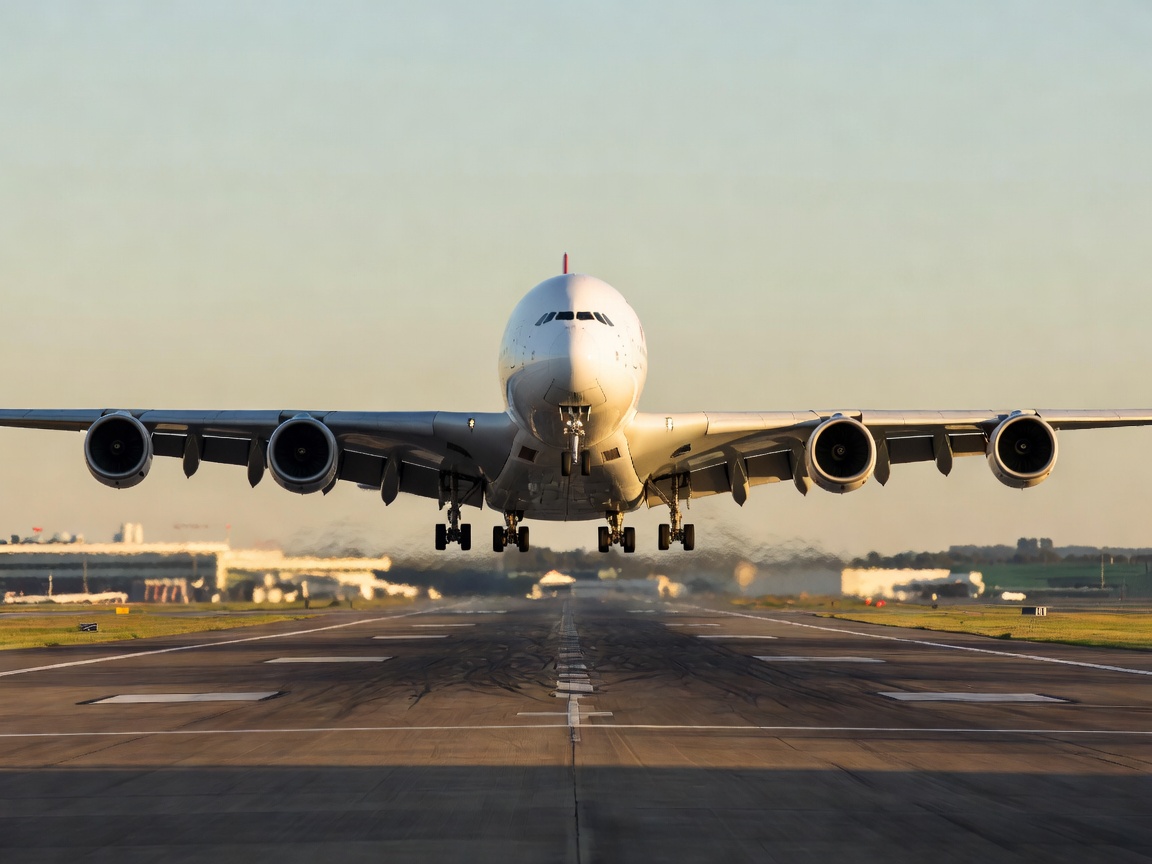
Engineering Challenges and Innovations
Designing an aircraft capable of carrying up to 853 passengers (in an all-economy layout) while complying with existing 80x80-meter airport gate footprints required immense innovation. The A380 features a unique composite center wing box and utilizes Glare—a glass-fiber aluminum laminate—in the upper fuselage to save weight. The hydraulic systems run at 5,000 psi rather than the standard 3,000 psi to reduce the size and weight of the extensive piping required.
The aircraft offered unparalleled passenger comfort, featuring a cabin significantly quieter than its contemporaries and offering floor space that airlines famously utilized to install first-class suites, showers, and onboard lounges.
| Specification | Details |
|---|---|
| Length | 72.72 m (238 ft 7 in) |
| Wingspan | 79.75 m (261 ft 8 in) |
| Maximum Takeoff Weight (MTOW) | 575 tonnes |
| Typical Passenger Capacity | 525 (3-class layout) |
| Range | 8,000 nm |
Market Reality and the Shift to Point-to-Point
Despite being an absolute triumph of aerospace engineering, the A380 faced a rapidly changing market reality. Rather than congregating at megahubs, passengers increasingly favored direct, point-to-point routes enabled by efficient, long-range twin-engine aircraft like the Boeing 787 and Airbus's own A350. These smaller, more fuel-efficient planes could operate profitably on secondary routes, diluting the demand for the ultra-high-capacity A380.
Furthermore, four-engine aircraft inherently burn more fuel and require more maintenance than twin-engine alternatives. Without the economies of scale that massive orders would have provided, the A380 struggled to achieve profitability for its manufacturer.
The Emirates Factor
The story of the A380 cannot be told without highlighting Emirates. The Dubai-based carrier became the lifeline of the program, ordering over 120 airframes—roughly half of all A380s ever built. The aircraft perfectly suited Emirates' geographical location and business model, serving as a global transfer hub connecting continents. When Emirates finally decided to shift future orders toward twin-engine alternatives, Airbus was left with no choice but to announce the end of production in 2019, with the final delivery occurring in 2021.
Legacy and Current Status
Though production has ceased, the A380 remains an iconic and highly popular aircraft among passengers. Many airlines prematurely retired their A380 fleets during global downturns, only to reactivate them as international demand surged and supply chains constrained the delivery of newer aircraft. The superjumbo is expected to grace the skies well into the late 2030s, standing as a monument to aerospace ambition.